



29 May Algarve Food Guide – The Restaurants and Traditional Food We Tried During Our Road Trip
Food was always going to be an important part of this trip through the Algarve.
We did not come to Portugal searching for luxury restaurants, Michelin stars, or places built specifically for Instagram photos. Instead, we wanted to try traditional food, local restaurants, small places filled with Portuguese people, grilled fish, soups, bifanas, cataplana, pastries, and desserts that belong to this region.
We have already talked about the best piri-piri chicken and the pasteis de nata we enjoyed in Algarve so today, this article will focus on the rest of our trip.
And honestly, what followed completely exceeded our expectations.
Adega da Marina — Lagos
On our very first evening in Lagos, we were exhausted.
Normally, after almost five hours of driving, picking up the rental car, reaching the accommodation, and then going out once again because you realize you still need small things like water or random supplies, there comes a moment when hunger hits you all at once.
And that is how we ended up eating at Adega da Marina on our very first night.
Maybe that dinner was the perfect beginning to the trip, or maybe it was the first extremely clear sign that food in Portugal was going to be incredible.
Imagine a huge dining room, almost like a hall, with tables placed one next to another. There were also a few smaller tables, but overall, the place was filled with groups of people eating together.

When we first entered, it was not completely crowded yet, but within the next fifteen minutes, before the first dish even arrived at the table, the restaurant was already full.
And honestly, this is probably exactly the type of Portuguese restaurant that I love.
Fast service, very friendly waiters, simple atmosphere, no unnecessary pretentiousness, just people coming there to eat well.
Now, let’s talk about the food.
First, we ordered the soup of the day. We had no idea what it was exactly, but we were tired, hungry, and simply wanted something warm.
It was excellent.

Then came the sardines, tuna, and bacalhau, and I think that was the exact moment when we realized that this trip could become something special.
Because the fish dishes we ate there were genuinely a 10 out of 10.
We absolutely loved the sardines covered in a salt crust, while the tuna served with roasted smashed potatoes and garlic was simply incredible.
It was one of those very good meals that immediately makes you excited and curious about all the other restaurants and dishes you are going to discover during the rest of the trip through the Algarve.
Tasca da Lota — Lagos
It is almost impossible to travel to Portugal without eating a lot of fish.
And either by luck or by good research beforehand, we ended up here, at Tasca da Lota, a restaurant located near the harbor on the opposite side of the Lagos promenade.
A simple place, with wooden benches, wooden tables, friendly waiters, and exactly the kind of relaxed atmosphere that makes you feel comfortable immediately.

We ordered dorada, robalo, and once again enjoyed the soup of the day, which was even better than the one we had at Adega da Marina.
So yes, we can already make a small ranking here.
The soup at Tasca da Lota was slightly better than the one at Adega da Marina.
Not by a massive difference, nothing dramatic, but somehow it simply tasted better — something confirmed by my fiancée as well.
The fish itself was grilled very simply and served with potatoes and salad.
Something so simple, yet so incredibly good.
Exactly the type of meal that you could eat repeatedly without ever getting tired of it.

As a small practical mention, there is a sign on the restaurant door saying that credit cards are not accepted. However, we paid using a debit card without any issues at all.
And this connects well with something you may have already noticed from the piri-piri article: many Portuguese dishes come with a small side dish included.
The piri-piri chicken came with fries, while the fish here arrived together with potatoes and salad.
So, the food is not only delicious but also prepared and served in a way that feels a little friendlier toward your budget as well.
Aqui Há Gato — Lagos
We wanted to try as many traditional Portuguese dishes as possible, so there was simply no way we were leaving Lagos without testing a bifana.
We chose Aqui Há Gato, a place located outside the old town, roughly several hundred meters away, almost one kilometer depending on where you start walking from.
It is located on the ground floor of an apartment building and feels exactly like the kind of place built for locals — for the people living in the nearby blocks, for workers stopping there for lunch — while also happily welcoming tourists attracted by the quality of the food.

We sat outside at one of the tables, enjoying the wind and the umbrella protecting us from the strong Algarve sun, and ordered two bifanas with pork, egg, and cheese.
And honestly, what can I say?
The bifana immediately became the type of sandwich that we both felt we could eat at absolutely any hour of the day or night.
It was an extremely pleasant surprise because we had never eaten a bifana before.
The bread was excellent, the pork was cooked incredibly well, and the addition of egg and cheese transformed the sandwich into something that honestly felt like a small culinary feast.
We enjoyed it enormously.
The service was very good, we genuinely have nothing negative to say about the experience, and if you want to try a proper bifana and do not mind walking around 700–800 meters outside the old town area, you can absolutely eat here without any worries.
It is also worth mentioning that we ended up eating bifana in two different places during this trip through the Algarve.
And while the bifana from Aqui Há Gato was genuinely excellent, for us it ultimately remained in second place.
We are keeping the number one spot as a small surprise for a little later in the article, as we continue moving through the restaurants and food experiences from this trip.
Casa Algarvia — Carvoeiro
After a long day spent visiting Benagil Cave, exploring Praia da Marinha and walking around Carvoeiro, we finally decided that we had waited long enough and that it was time to try one of the most traditional and specific dishes from the Algarve region: cataplana.
Cataplana is essentially a type of stew cooked inside a special metal pot, and depending on the restaurant or your preferences, it can contain shellfish, fish, or even combinations such as pork with clams.
This was the first place where we tried cataplana during the trip.
And honestly, as you can probably already see from the photos, the portion was enormous.
We ordered the cataplana for two persons and it arrived in a massive serving dish together with an extremely generous side portion of rice.

We were completely full by the end of the meal.
Without question, it was one of the most interesting dishes we ate during the entire trip through the Algarve.
Unfortunately, I could not properly pair it with a glass of wine because I still had to drive afterward, but even so, the experience itself was fantastic.
This is absolutely one of those dishes that must be experienced if you are visiting the Algarve.
I can easily recommend it to anyone.
The portion was huge, and the total price was somewhere around 40–44 euros for two people, which honestly felt more than reasonable considering the size of the cataplana and the amount of rice included alongside it.
Excellent.
In our personal ranking from this trip, this restaurant still ended up in second place when it comes to cataplana.
Because yes, there was another restaurant where we ate an even better one.
But we will get there a little later in the article.
Casa Sete Estrelas — Olhão
I honestly do not even know exactly how we ended up here.
We had just spoken with the hotel staff in Albufeira about changing our room, as I already detailed in the accommodation article, and after visiting Tavira we decided to stop in Olhão.
Once there, we simply started walking around without any real guide or clear plan.
We wanted to explore as many streets as possible through the old town area.
We did have a few restaurants saved on our phones, and in our minds, we were already thinking about fish, seafood, and what we wanted to eat next.

But surprisingly — and we genuinely did not expect this — Olhão was probably the place where we saw the highest number of fully packed restaurants during the entire trip.
At four or five restaurants we originally wanted to try, we simply could not find a free table, and in front of some of them there were actual waiting lines that we did not feel like standing in.
Because during our trips, one thing matters a lot to us: we want to see places, walk, explore, and minimize the amount of time spent waiting around inside restaurants.
So, we basically had two options:
either leave without eating and head back toward Albufeira or stop somewhere small and local.
And that is how we ended up at Casa Sete Estrelas.
A tiny local restaurant filled with football memorabilia on the walls — scarves, pennants, team photos — the kind of place that immediately feels authentic.
We simply ordered exactly what we had seen on the tables around us, where locals were eating calamari in sauce together with sandwiches and beer.
The service was excellent.
We joked with the staff, managed to understand each other despite the language barrier, and it became one of those small interactions that somehow stay in your memory long after the trip ends.
As for the food itself, it was very good.
Not the type of meal where you immediately call home and say, “This is the best thing I have ever eaten.”
Rather, it felt like honest, everyday food — the kind of dish someone cooks regularly at home and the kind of flavor you could easily get used to as part of normal life.
Very, very good.
I am sure that many tourists would probably walk right past this place.
But if you are in a hurry and do not want to spend two hours standing in line waiting for famous restaurants, maybe this is exactly the kind of spot where you can stop, relax, and enjoy a portion of octopus or calamari without overthinking everything.
And unfortunately, because of a small language misunderstanding, I ended up ordering a sandwich instead of a bifana.

Which is slightly tragic, because otherwise I would have had three different bifana experiences to compare during this trip instead of only two.
Tasca do Ricky — Faro
This was the best cataplana we ate during the entire trip.
The kind of small local restaurant with maybe nine tables in total, six of them already reserved.
We arrived right at 7 PM when the place opened and luckily managed to grab the first available table out of the only three that were not reserved.
The service was fantastic.
The head waiter — or maybe the owner, we were never completely sure — was constantly joking, speaking with customers, making recommendations, and creating exactly the kind of atmosphere that makes a restaurant feel alive.
We ordered a cataplana for two with pork, shellfish, and clams.

And honestly, it had one of the best flavors I have ever tasted.
I genuinely cannot recommend this restaurant enough if you want to try cataplana in Faro.
From what we overheard while the restaurant slowly filled up around us, cataplana was exactly the reason why more than half of the customers had specifically come there.
Pricewise, it was slightly more expensive than the one we had at Casa Algarvia and, surprisingly, it did not come with the generous rice or bread side dishes we received there.
But even so, I honestly cannot subtract a single point because the quality of the flavor itself was incredible.
This is exactly the kind of dish that stays in your memory long after the trip ends.
The type of flavor you continue searching for later whenever you return to Portugal and order cataplana somewhere else, hoping to find that same taste again.
So, when it comes to cataplana, our personal ranking from this trip through the Algarve ended up looking like this:
1. Tasca do Ricky — Faro
2. Casa Algarvia — Carvoeiro
Both were excellent and worth trying, but for us, the flavor and overall experience at Tasca do Ricky in Faro ultimately took first place.
Snack Bar da Xica — Faro
The perfect bifana.
We genuinely thought we had already eaten a very good bifana in Lagos, but all those plans and rankings completely collapsed the moment we tasted the bifana here for the first time.
Absolutely incredible.

Even my fiancée, who had already loved the bifana from Lagos, was completely impressed and immediately asked me if we could come back and eat there again.
And as a bonus, this was also the place where we discovered sopa do dia — a soup that turned out to be fantastic.
Beans, chickpeas, pieces of chorizo, greens… rich, warm, comforting, exactly the kind of food that instantly makes sense when you taste it.

We only ordered it because when we entered the place — where honestly 99% of the customers seemed to be construction workers, locals, workers on lunch break, families, almost entirely Portuguese people — nearly every single person had this soup sitting in front of them.
And that usually tells you everything you need to know.
But to truly understand how good the bifana was here, you need to understand one thing:
During the entire time we stayed inside Snack Bar da Xica, every single table ordered bifana.
People arriving ordered bifana. People preparing to leave had eaten bifana. New customers coming in ordered bifana.
There was practically not a single table without it.

Some people also added coffee, drinks, soup, or something else on the side, but the bifana was clearly the heart of the place.
The service was excellent, fast, relaxed, efficient — honestly nothing to complain about.
And the entire experience made me understand something important:
what a simple dish can become when it is made perfectly.
Because at the end of the day, bifana is “just” a sandwich.
But here, it became something memorable.
Restaurante Xic — Faro
We simply could not leave Portugal without trying the absolute monster known as francesinha.
So, we searched for a restaurant where we had the highest chances of finding a good version of it, considering it is one of the country’s most famous specialties, and for our first attempt we ordered half a francesinha together with a pica-pau.
And yes, the correct name is pica-pau.

Pica-pau is made from strips of pork cooked in a rich garlic sauce, usually served together with toasted bread, and honestly, it was insane.
We kept eating and looking at each other in disbelief because we genuinely could not understand how something so simple could taste that good.
As for the francesinha itself, we initially ordered only half of one.

But after tasting it, we immediately got greedy and said:
“Alright, now we need a full one too.”
So, we ordered an entire francesinha afterward.
And honestly, this is not the type of food I could personally eat every single day the way I could easily eat bifana.
Francesinha is a monster.
Heavy, massive, filled with absolutely everything: pork, different meats, shrimp, sauce, egg, melted cheese and so on.

It is one of those dishes that completely overwhelms you in the best possible way.
But even so, it was a special experience.
The flavor was incredible, the service was excellent, and if you want to try a proper francesinha at least once during a trip through the Algarve, you can absolutely do it here without any problems at all.
Dom Rodrigo — Traditional Algarve Dessert
And finally, we left dessert for the end.
Here we have one of the sweets that feels deeply connected to the Algarve region and especially to Lagos: the famous Dom Rodrigo.
We tried it in two different places: Pastelaria Algarve in Lagos and Pastelaria Tavirense in Tavira.
Both were delicious.
But one thing needs to be said very clearly: this is a heavy dessert.
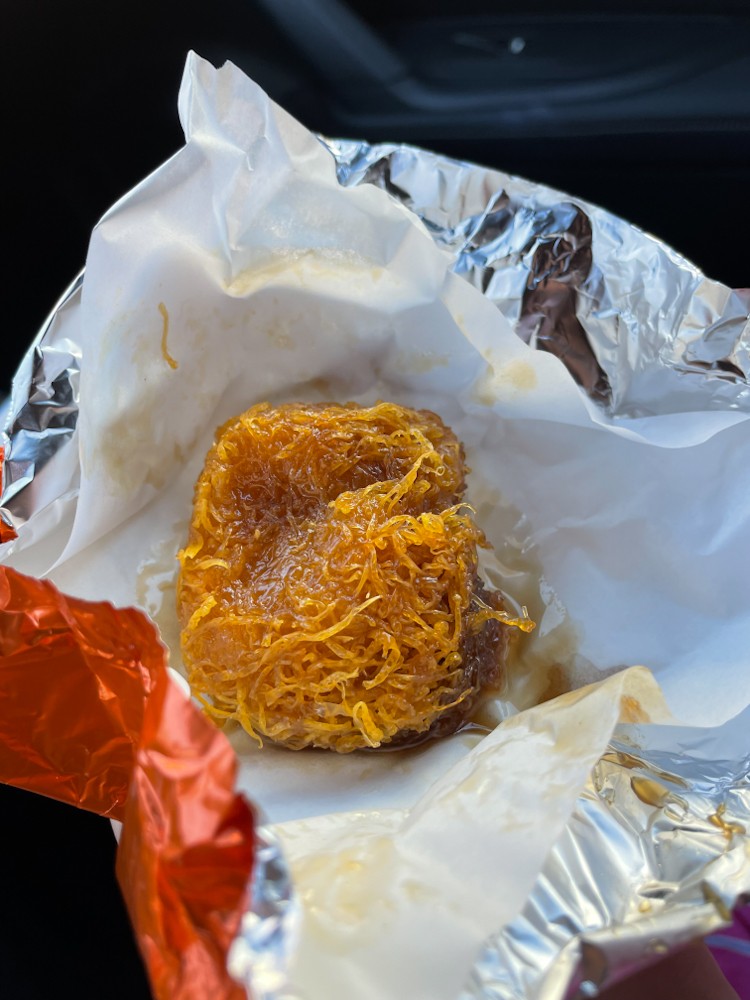
Very heavy.
Honestly, at least for me personally, pasteis de nata feel much easier to digest than eating two or three Dom Rodrigo desserts.
But even so, this is absolutely one of those traditional sweets worth trying at least once while visiting the Algarve.
If I had to make a small ranking between the two versions we tried, my favorite was the one from Pastelaria Tavirense, followed extremely closely by the version from Pastelaria Algarve.
Honestly, you cannot really go wrong with either of them.
It is exactly the kind of traditional dessert that deserves at least one chance during a trip here, so you really have nothing to lose by trying it.
Of course, we also ate one or two other cakes and pastries during the trip, whether in Lagos or at Trigo Dourado in Faro.
But honestly, I do not want to fill pages talking about them.
They were good, perfectly fine, but nothing particularly traditional or memorable.
Sometimes we simply wanted a tart, a random cake together with a coffee, or something sweet during the day without necessarily searching for a culinary experience.
For us, the true traditional dessert foundation of this trip remained, without question, pasteis de nata and Dom Rodrigo.
Conclusion
For the first time in my life, after so many trips, restaurants, countries, and continents, I must admit that I feel slightly embarrassed because I allowed myself to leave for this trip with a prejudice already in mind.
And as it turned out, I was completely wrong.
Before arriving in the Algarve, I suspected that because the region is so heavily touristic, much of the food might be adapted or modified specifically to satisfy tourists visiting the area.
I was enormously mistaken.
If in the past I said that I had eaten incredible food in Italy, Spain, or Greece, at least for now, both my fiancée and I ended up placing Portugal above all of them when it comes to food quality and especially the consistency of that quality across the large number of restaurants we tried.
And just imagine this: between the piri-piri article, the pasteis de nata article, and this large food article, we are probably talking about 18 different restaurants.
And if we remove that one restaurant from Albufeira — which honestly disappointed us mostly because the piri-piri sauce itself was not at the expected level — we still ended up with more restaurants where we ate delicious food than in any other region we have visited so far.
And honestly, that is incredible.
It also makes us extremely curious to discover what food might taste like in other regions of Portugal in the future.
If you are curious about our itinerary you can read the article here
And if you want to see which places we picked for our bases and the accommodation we used, you can read the article here
No Comments